
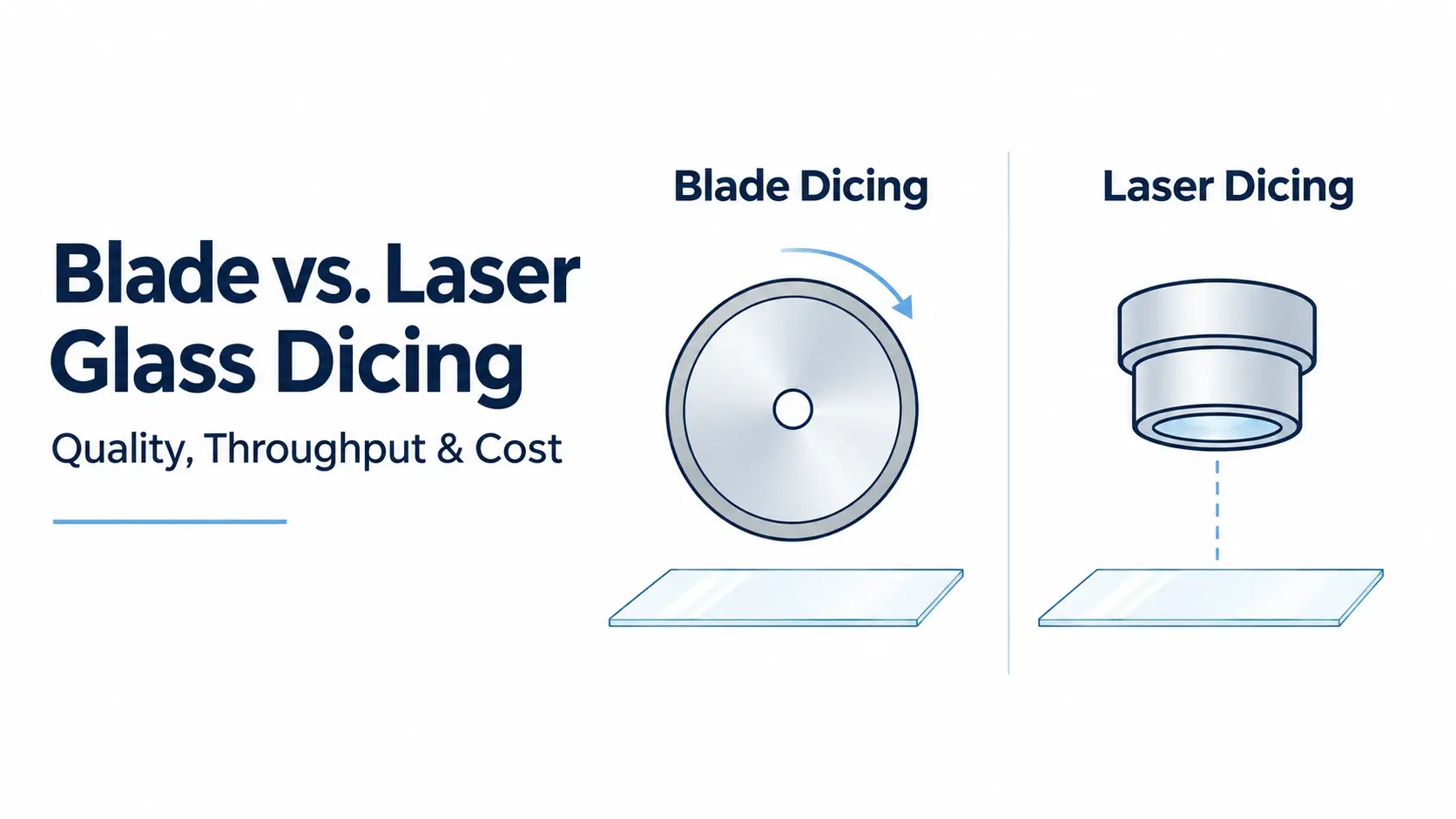
Blade vs. Laser Glass Dicing: Comparing Quality, Throughput and Cost
Blade and laser glass dicing offer different ways to separate glass substrates into smaller components. The better fit depends on the finished part, the material and the complete production workflow.
An established blade process provides a useful baseline for qualified straight-cut layouts. A specific laser process may be worth evaluating when geometry, material utilization or quality requirements change.
For engineering and purchasing teams, the decision involves more than cutting speed. Preparation, cleaning, separation and handling all affect how many acceptable components the process delivers—and at what cost.
At YJ Stainless, we manufacture stainless steel frames for tape-mounted applications. This article compares the factors involved in process selection and explains when production changes may create new frame requirements.
When Is Blade or Laser Glass Dicing Worth Evaluating?
The starting point is the component you need to produce and the evidence available for each proposed process.
An existing production route provides a reference for quality, output and operating cost. An alternative can then be assessed against the same acceptance criteria and delivered condition.
Blade Dicing for Established Straight-Cut Layouts
Blade dicing removes material with a rotating abrasive blade and is commonly used for repeated straight cutting paths.
Where a blade process already produces acceptable parts, its production records provide a useful comparison. They can show the relationship between cutting conditions, consumable use, handling and finished output.
Fraunhofer ENAS’s dicing capabilities include glass and bonded glass substrates. Its workflow incorporates tape mounting, vacuum chucking, alignment and automatic cutting, illustrating the supporting operations involved.
Laser Dicing for Different Application Requirements
Selected laser methods support curved paths and other geometries. Certain processes also offer very low kerf loss, which may be relevant to material utilization.
The specific method matters. Laser ablation removes material, while other approaches modify the glass before a subsequent separation operation.
DISCO’s laser processing explanation distinguishes ablation from Stealth Dicing. Identifying the proposed method makes the comparison more useful than treating all laser processing as equivalent.
Compare Finished Quality on the Same Glass
Both proposals need to address the same glass specification, component geometry and acceptance criteria.
Glass composition, thickness, coatings and substrate construction can influence processing behavior. Results from an uncoated sample may not represent a coated production part.
Depending on the application, quality evaluation may include:
- Upper and lower edge chipping.
- Cracks or other edge defects.
- Dimensional accuracy.
- Surface and coating condition.
- Edge strength, where specified.
These characteristics answer different questions. A clean-looking edge does not, by itself, establish dimensional accuracy or strength.
How Useful Are Published Application Results?
Published demonstrations show what a tested combination achieved.
For example, Hamamatsu’s thin-glass application study demonstrates ultrafast laser ablation on specific glass samples, including curved cutting paths.
Such findings can support an initial evaluation. Trials using the intended substrate, layout and inspection criteria help establish their relevance to production.
Comparable inspection methods also matter. Images taken at different magnifications or measurements based on different definitions of chipping can make the results difficult to assess.
Compare Complete Throughput, Not Just Cutting Speed
Production throughput depends on how quickly accepted components become available to the next operation.
Mounting, alignment, surface protection, cleaning, separation, inspection and unloading may all contribute to the complete cycle. Transfers between machines can also affect how the route fits an existing line.
A faster cutting step is valuable, but its effect on overall output depends on the surrounding operations.
Does Laser Processing Complete the Separation?
Not always.
Some methods remove material to separate the components. Others create a path that requires a later breaking or expansion operation.
Corning’s glass dicing process, for example, combines modification with separation that can use automated breaking on stretch tape.
A fair cycle-time comparison ends with both routes delivering components in the same required condition. Timing one route before separation and another after separation would compare different outputs.
Preparation and Cleaning Belong in the Cycle
Preparation and cleaning requirements depend on the material and processing method.
DISCO describes protective coating and subsequent cleaning as part of its approach to controlling particle adhesion during ablation. These operations affect the complete route even though they are separate from laser exposure.
Processing proposals are easier to compare when they identify the included operations and where the timed cycle begins and ends.
Evaluate Material Utilization and Cost Together
A narrower separation path may improve material utilization, but the practical benefit depends on the layout.
Blade cutting creates a kerf through material removal. Laser ablation also removes material, while certain modification-based methods offer very low kerf loss.
The useful comparison is whether the qualified layout produces more acceptable components from each substrate. Required spacing, edge exclusion areas and processing results all contribute to that assessment.
Cost extends beyond machining. Equipment, consumables, labor, maintenance, cleaning, inspection and rejected material may affect the result.
| Comparison Area | Useful Evidence | Purchasing Relevance |
|---|---|---|
| Finished quality | Results against equivalent dimensional, edge and surface requirements | Whether both routes deliver acceptable components |
| Complete throughput | Preparation through the agreed finished condition | Output beyond the cutting-speed figure |
| Material utilization | Qualified layouts and accepted parts per substrate | The practical value of spacing and kerf differences |
| Operating costs | Application-specific consumables, maintenance, labor and utilities | Recurring production costs |
| Quotation scope | Included separation, cleaning, inspection and packaging | Whether prices cover equivalent deliverables |
| Production integration | Equipment, handling and component changes | What is required to adopt the proposed route |
Cost per accepted component helps connect these factors when the included costs and comparison period are consistent.
For outsourced processing, quotation scope deserves particular attention. A price covering machining alone is different from one including preparation, separation, cleaning and inspection.
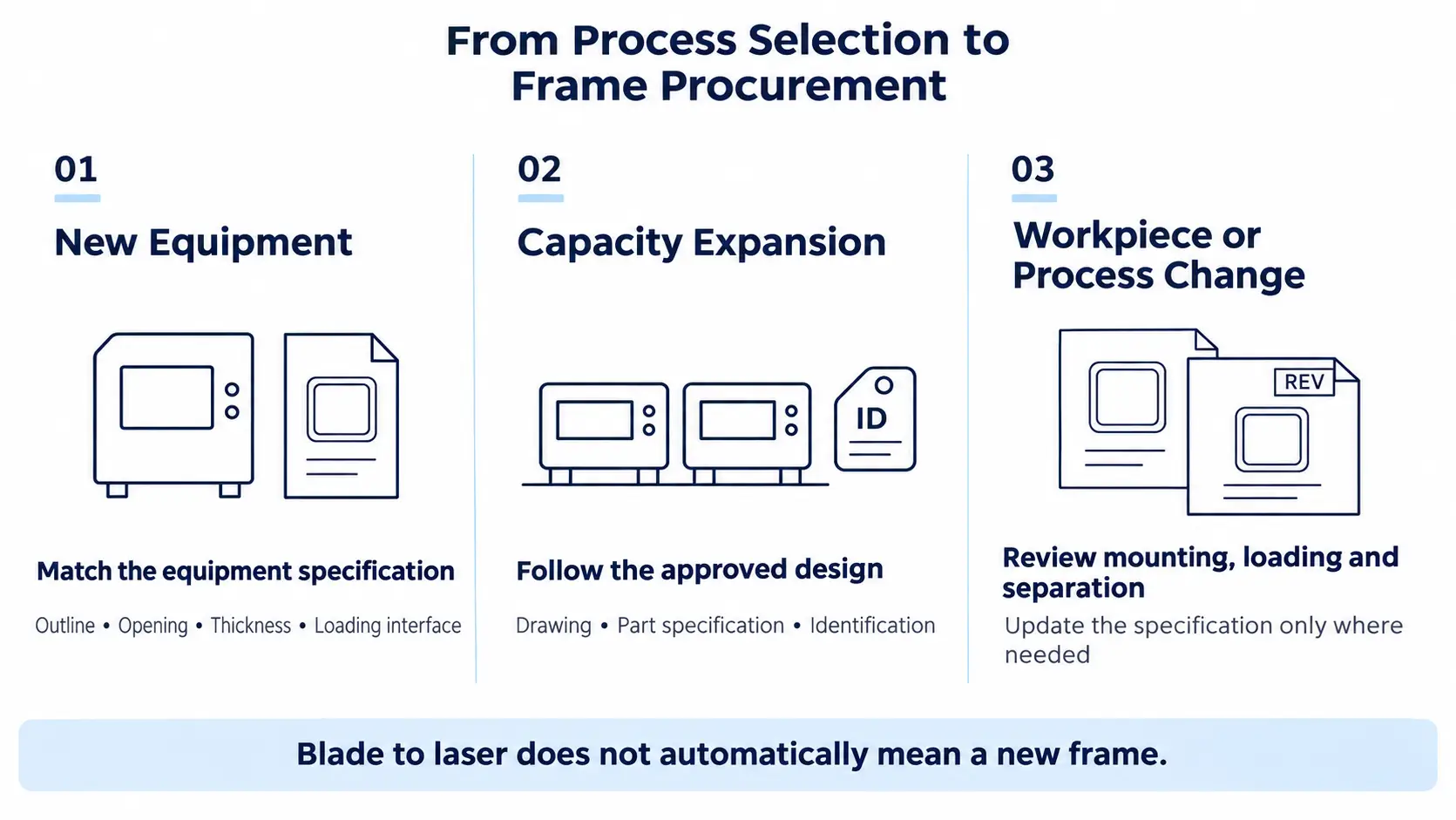
From Process Selection to Frame Procurement
Once a processing route is defined, the discussion moves to the components required for production.
For setups using metal tape frames, three situations can create a frame-sourcing requirement.
1. Introducing New Equipment
New equipment may specify a frame outline, opening, thickness and loading interface.
The purchasing requirement is to obtain frames matching that specification. An existing design may be suitable, or the equipment configuration may call for a custom component.
2. Adding Production Capacity
An additional line may require more frames of an established design.
The approved drawing and part specification provide a reference for manufacturing. Identification markings can also help distinguish frames assigned to different products or configurations.
3. Changing the Workpiece or Process
A different glass layout or handling arrangement may introduce a revised frame requirement.
Switching from blade to laser processing does not automatically require a new frame. The mounting, loading and separation arrangements determine whether the existing design remains suitable.
Where a change is needed, the revised specification establishes the component to be manufactured.
How We Support Your Frame Requirements
At YJ Stainless, we manufacture stainless steel frames and evaluate custom geometry, dimensions, thicknesses and machined features.
Our frame customization services include CNC machining and laser identification marking.
For new equipment, additional production capacity or a defined design change, we can review the component requirements and assess manufacturing feasibility. Your equipment and process team confirms application suitability; we focus on producing the frame to the agreed specification.
Conclusion
Blade and laser glass dicing are best compared through finished quality, complete throughput, material utilization and cost.
Once the production route is selected, engineering and purchasing teams can define the supporting components needed to implement it.
If your project involves new equipment, additional frames or a revised frame design, contact us to discuss manufacturing requirements. An existing drawing and a description of any proposed changes provide a useful starting point.
FAQs
1. Is laser glass dicing always better than blade dicing?
No. The choice depends on the material, geometry, quality requirements and complete workflow. Results from the intended application provide a stronger comparison than the process name alone.
2. Does faster cutting mean higher production output?
Not necessarily. Preparation, separation, cleaning, handling and inspection can affect total throughput.
3. Does lower kerf loss always reduce component cost?
No. The benefit depends on the qualified layout, accepted output and other processing costs.
4. Will switching from blade to laser require different frames?
Possibly. The equipment interfaces and mounting and separation arrangements determine whether the existing frame specification remains suitable.
5. Can YJ Stainless manufacture frames for new or expanded production?
We can evaluate manufacturing for specified frames, including additional units of an existing design, replacements and revised components.


