
Ceramic Dicing: Materials, Methods and Process Overview
Ceramic dicing separates a ceramic substrate into smaller components with defined dimensions. It is used in electronic substrate and package manufacturing, where finished parts may need controlled edge quality, dimensional accuracy and protection of existing circuit features.
Diamond blade dicing is one processing route. Laser processing is another option for selected materials and designs. The appropriate method depends on the ceramic, its thickness, any added layers and the required finished condition.
Some setups use adhesive tape mounted on a metal frame. At YJ Stainless, we manufacture stainless steel frames and can assess production to the frame drawing specified for such an application.
This overview explains the materials, cutting methods, basic workflow and workholding options involved.
What Is Ceramic Dicing?
Ceramic dicing is a precision separation process used to produce individual parts from a larger ceramic substrate or wafer.
The substrate may be divided before or after metallization and other features are added. A plain ceramic panel and a patterned circuit substrate can therefore present different processing requirements, even when their external dimensions are similar.
The complete workpiece structure matters alongside the ceramic material itself.
Which Ceramic Materials Are Diced?
Alumina and aluminum nitride are two ceramic substrate materials used in electronics. Both can be diced, but their properties and applications differ.
1. Alumina Substrates
Alumina, or aluminum oxide, combines electrical insulation with mechanical strength. Electronic applications include thick-film and thin-film substrates.
Kyocera’s alumina product information includes substrates for these circuit applications. Dicing can divide a larger substrate into sections for subsequent assembly.
The material grade, thickness and features already present help define the cutting requirement.
2. Aluminum Nitride Substrates
Aluminum nitride, commonly written as AlN, is used where heat dissipation and electrical insulation are important.
Kyocera describes AlN substrates and packages for electronic applications, including structures with thin-film metallization.
The finished component’s geometry and added features form part of the dicing requirement. Processing conditions established for alumina are not automatically suitable for AlN.
3. Metallized and Layered Ceramic Substrates
Some ceramic substrates include metal layers, patterned circuits or bonded structures.
Valley Design’s ceramic dicing capabilities cover different materials and surface conditions, including metallized substrates.
For these parts, evaluation extends beyond separating the ceramic body. It may also include the required condition of coatings, circuit features and areas adjacent to the cut.
How Are Ceramic Substrates Diced?
The main distinction is how the cutting tool interacts with the workpiece.
Diamond Blade Dicing
Blade dicing uses a rotating abrasive blade to remove material along a programmed path. This produces a kerf—the material removed between adjacent components.
Blade specification, cutting conditions, cooling and workpiece support are considered together when developing the process.
ADT’s ceramic and alumina solutions identify upper and lower edge chipping, cut perpendicularity and blade life as application challenges. These illustrate why a successful process needs to achieve more than the required outline.
Laser Dicing
Laser processing uses focused laser energy to create the required cutting path. The interaction depends on the material and the specific laser process.
Nichiwa describes laser processing for applications including alumina ceramic. This establishes an available route for selected applications rather than a general alternative for every ceramic substrate.
Blade and Laser Dicing Compared
| Comparison | Diamond Blade Dicing | Laser Dicing |
|---|---|---|
| Processing mechanism | A rotating abrasive blade removes material | Laser energy interacts with the material through the selected process |
| Cutting-tool contact | The blade contacts the workpiece | No blade contacts the cutting path; workholding is still required |
| Material loss | A kerf is created by material removal | Depends on the proposed laser method |
| Process evaluation | Blade specification, cooling, cutting conditions and support | Material response, laser process and separation requirements |
| Finished-part assessment | Dimensions, edge condition, cut perpendicularity and surface integrity | Dimensions, edge condition, surface integrity and process-specific effects |
Neither process name alone establishes the result. Comparisons are most useful when they use the intended material, component layout and acceptance criteria.
What Is the Basic Ceramic Dicing Workflow?
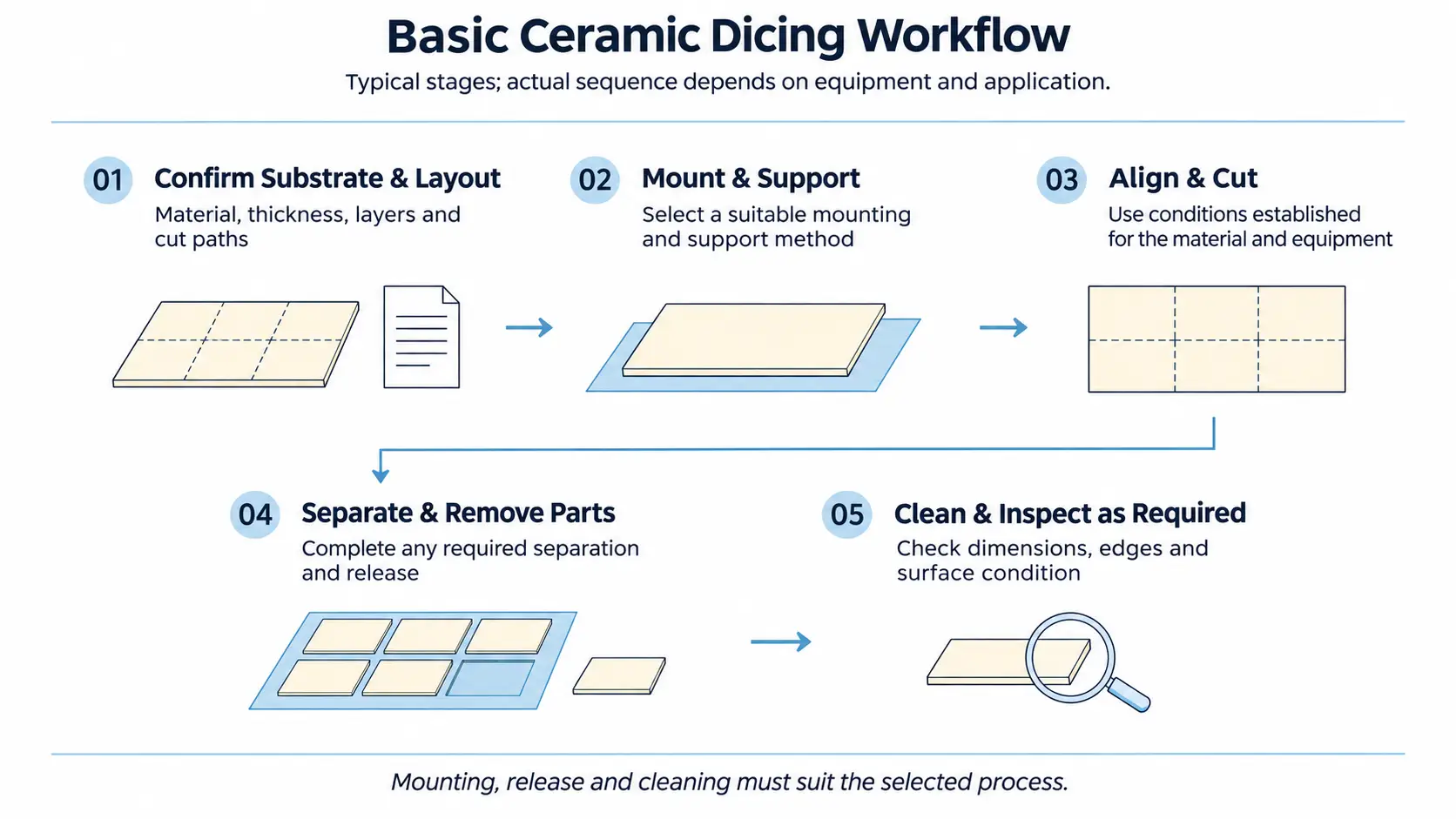
The exact sequence depends on the equipment and application. A typical route can be understood through five stages.
1. Confirm the Substrate and Cut Layout
The starting information includes the ceramic material, thickness, dimensions and any coatings or metal layers.
The layout defines the components to be produced and the paths used to separate them.
2. Mount and Support the Workpiece
The substrate is held using an arrangement suitable for the equipment and process. Options may include adhesive tape, wax bonding or another support method.
Where a tape frame is used, its geometry forms part of the loading and handling interface.
3. Align and Perform the Cutting Operation
The workpiece is positioned relative to the programmed paths, and the selected cutting process is carried out.
Operating conditions are established for the material, equipment and intended result. Published parameters from another application provide context rather than a ready-to-use recipe.
4. Complete Separation and Part Removal
Depending on the process, the components may already be separated or may require further release or handling.
Tape-mounted parts can remain on the mounting medium until the relevant removal operation.
5. Clean and Inspect as Required
The finished components are assessed against the specified dimensions, edge condition and surface requirements.
Cleaning and release operations form part of the complete workflow, particularly where the next operation has defined surface or handling requirements.
What Affects Ceramic Dicing Quality?
Quality depends on the interaction between the substrate, cutting method and support arrangement.
1. Material and Substrate Structure
The ceramic grade and added layers define the workpiece being processed. A trial on a plain sample does not establish performance on every metallized or layered version.
2. Cutting Conditions and Tool Performance
Blade condition and cutting load are relevant to blade processing. For laser processing, the material response and proposed method form part of the evaluation.
These factors are assessed against the intended application rather than a universal operating setting.
3. Workpiece Support
The mounting arrangement holds the substrate through cutting and subsequent handling.
In a framed setup, the metal frame supports the tape assembly. The tape provides adhesion, while the equipment supplies the processing support and positioning arrangement.
4. Finished-Part Requirements
Inspection may include dimensions, upper and lower edge chipping, cut perpendicularity and damage near existing features.
Defined acceptance criteria connect the dicing result with the component’s intended use. They provide a clearer basis for evaluation than broad descriptions such as “high precision” or “chip-free.”
How Are Ceramic Substrates Held During Dicing?
Workholding determines how the substrate is supported, loaded and later removed.
TAMA Electronics describes ceramic cutting using mounting options such as dicing tape and wax. These approaches create different support and release requirements.
Tape and Metal Frames
In a framed tape-mounted setup, the substrate adheres to dicing tape attached to a surrounding frame.
The opening accommodates the workpiece and tape layout. The external profile, thickness and loading features follow the equipment interface.
A rectangular substrate therefore does not necessarily require a rectangular external frame profile.
Wax Bonding and Other Support Arrangements
Some applications use wax bonding or other workholding methods.
The suitable arrangement depends on the substrate and processing requirements. Metal tape frames are relevant to particular setups rather than every ceramic dicing process.
How We Support Ceramic Dicing Applications
For ceramic dicing setups designed to use metal tape frames, the frame is a separate component with its own manufacturing specification.
The adhesive tape holds the ceramic substrate. The surrounding frame supports the tape assembly and provides the interface for equipment loading and handling.
At YJ Stainless, we manufacture stainless steel frames and can assess production of this component from the specified drawing.
Custom Frame Geometry and Machining
The substrate layout may require a particular opening, while the equipment defines the external profile, thickness and loading features.
We review these details together to assess manufacturing feasibility. Our Square Wafer Frame TJF-C illustrates our made-to-order frame capabilities.
Replacement Frames and Design Changes
We can assess manufacturing for an existing frame specification or a revised design following an equipment or workpiece change.
Our custom processing services include CNC machining and laser identification marking.
Your equipment and process team confirms application suitability. We assess how to manufacture the frame to the agreed specification.
Conclusion
Ceramic dicing brings together the substrate material, cutting method, workholding and finished-part requirements.
Alumina, AlN and metallized substrates need to be evaluated as complete workpieces. The appropriate route includes mounting, cutting, release and inspection—not just the separation operation.
Where the selected setup uses a metal tape frame, our role is to assess manufacturing of that specified component. Contact us with your frame drawing or existing component details to discuss a new, replacement or revised frame.
FAQs
1. What is ceramic dicing used for?
It separates larger ceramic substrates into individual components for applications such as electronic circuits, substrates and packages.
2. Can alumina and aluminum nitride be diced?
Yes. Specialist suppliers process both materials. The appropriate route depends on the substrate specification, structure and finished-part requirements.
3. Is blade or laser dicing better for ceramics?
Neither is universally better. The choice depends on the material, geometry, quality requirements and complete processing workflow.
4. Does every ceramic dicing setup use a metal frame?
No. Workholding may involve tape-supported frames, wax bonding or other arrangements, depending on the application and equipment.
5. Can YJ Stainless manufacture a custom frame for a specified setup?
We can review drawings for stainless steel frame manufacturing and custom processing. The customer’s technical team confirms suitability for the equipment and application.


