
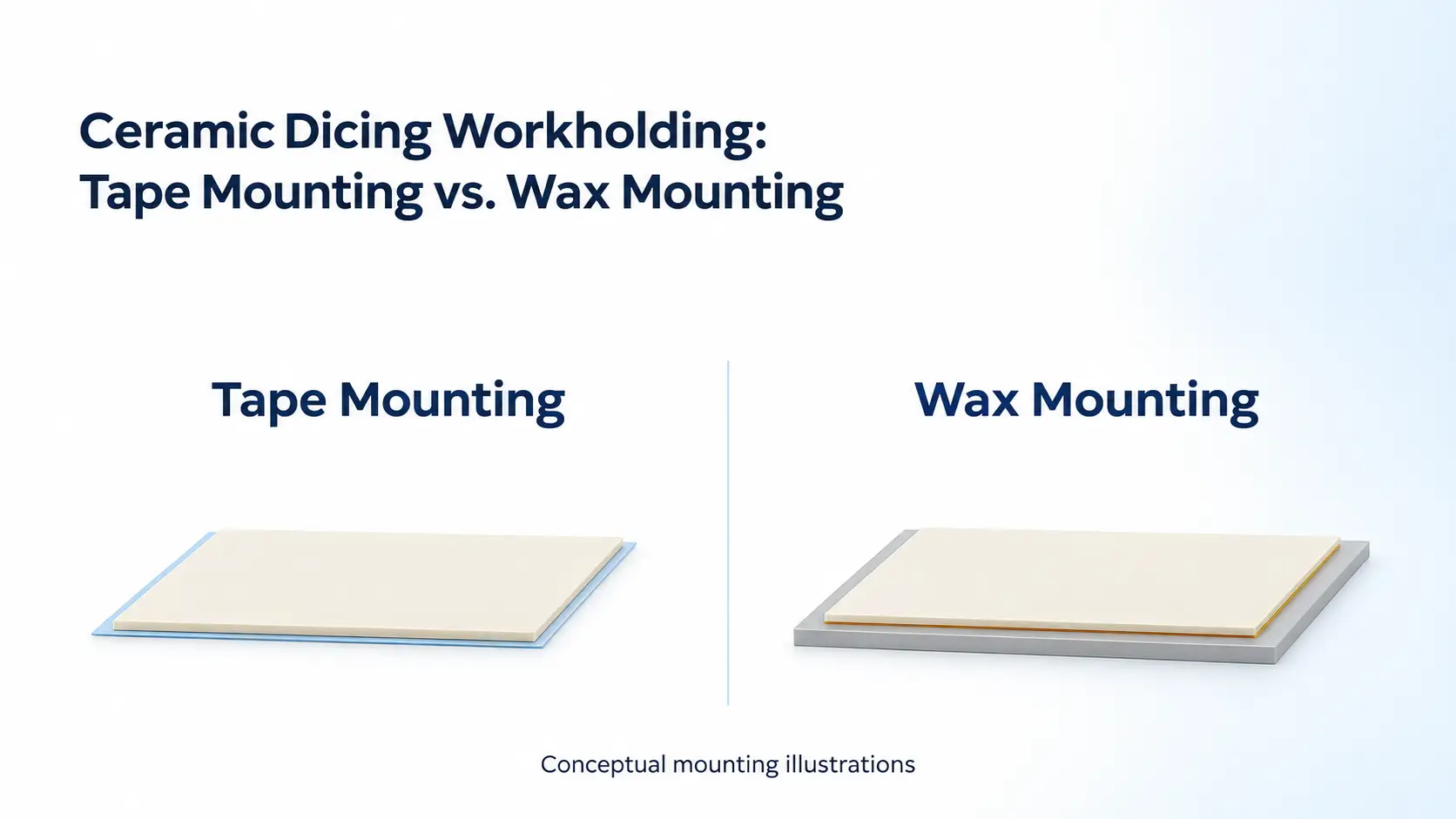
Ceramic Dicing Workholding: Tape Mounting vs. Wax Mounting
In ceramic dicing, the mounting method affects how a substrate is supported during cutting and how the separated components are removed afterward.
Two options are mounting the substrate on adhesive tape and bonding it to a supporting carrier with wax. Each arrangement involves different components, equipment interfaces and release steps.
At YJ Stainless, we manufacture stainless steel frames. For ceramic dicing setups that use metal tape frames, we can assess new frame production, additional quantities, replacements and design revisions against the specified requirements.
For background on materials and cutting methods, see our ceramic dicing process overview. This article focuses on mounting choices and when they create a metal frame sourcing requirement.
What Is the Difference Between Tape and Wax Mounting?
In a framed tape-mounted setup, the ceramic substrate adheres to an adhesive film attached to a surrounding frame.
In wax mounting, the substrate is bonded to a supporting surface with wax. The carrier sits beneath the workpiece and forms part of its support arrangement.
TAMA Electronics describes ceramic cutting using both dicing tape and wax, with the method selected according to the application.
The choice concerns the complete mounting arrangement, including how the workpiece is held, loaded and released.
How Tape Mounting Works in Ceramic Dicing
Dicing tape retains the ceramic substrate and separated components. Where a metal frame is used, it supports the tape assembly for equipment loading and handling.
1. The Tape Holds the Workpiece
The adhesive film holds the substrate through the relevant cutting and handling operations.
Tape selection and mounting conditions are connected to adhesion and subsequent part removal. The frame supports the film assembly but does not replace its adhesive function.
2. The Frame Provides the Loading Interface
The frame gives the equipment a defined geometry for loading and handling the mounted workpiece.
Its external profile, thickness and loading features follow the equipment configuration. The internal opening accommodates the substrate and tape layout.
This is where a frame manufacturer becomes relevant: the component needs to be produced to the dimensions and features specified for the setup.
3. Equipment Support Completes the Arrangement
The machine’s chuck or processing support is another part of the system.
The tape, frame and equipment perform different functions. A question about local support beneath the ceramic is therefore not automatically a question about the surrounding metal frame.
How Wax Mounting Works
In wax mounting, the ceramic substrate is bonded to a supporting carrier.
ADT’s reference on dicing hard and brittle materials describes attaching a delicate workpiece to a solid supporting substrate using wax.
The carrier and bonding layer provide support beneath the workpiece. After cutting, the components need to be released.
Depending on the wax and removal method, the route may involve heating and cleaning. These operations can limit suitability where the product cannot tolerate the associated conditions.
The evaluation therefore extends through cutting, release and the required final condition.
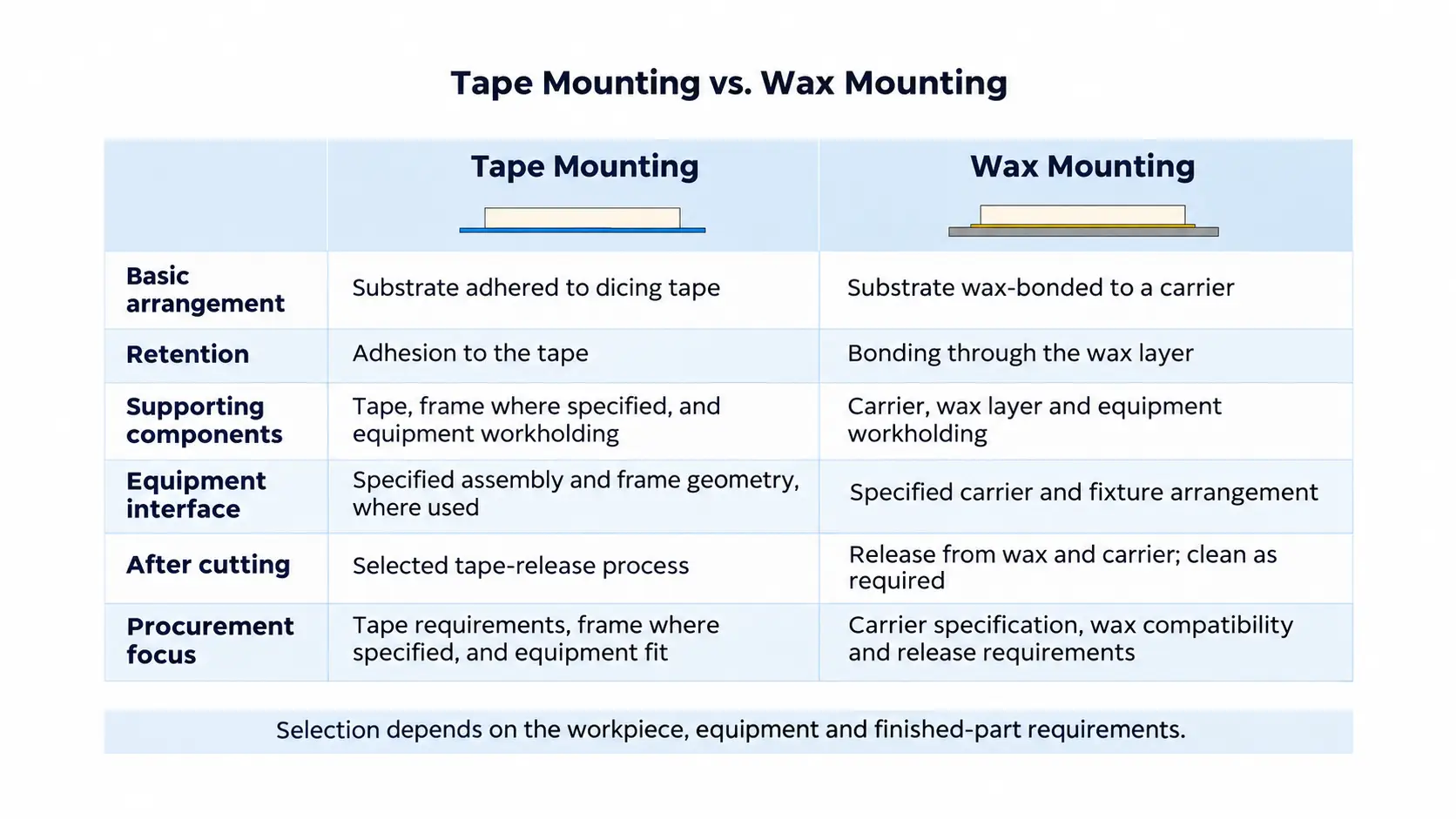
Tape Mounting vs. Wax Mounting
| Comparison | Tape Mounting | Wax Mounting |
|---|---|---|
| Basic arrangement | The substrate adheres to dicing tape, with a surrounding frame where specified | The substrate is bonded to a supporting carrier with wax |
| Workpiece retention | Adhesion to the tape | Bonding through the wax layer |
| Supporting components | Tape, frame where used, and equipment workholding | Carrier, wax layer and equipment workholding |
| Equipment interface | The specified tape-mounted assembly and frame geometry | The specified carrier and fixture arrangement |
| After cutting | Removal through the selected tape-release process | Release from the wax and carrier, followed by required cleaning |
| Procurement focus | Tape requirements, frame specification and equipment fit | Carrier specification, wax compatibility and release requirements |
The appropriate choice depends on the workpiece, equipment and finished-part requirements.
What Determines the Appropriate Mounting Method?
A useful comparison considers whether the substrate remains adequately held during cutting, whether finished components can be released acceptably and how the complete route fits production.
UKAM’s mounting guidance discusses adhesion, substrate contact and mounting-media selection as relevant factors in dicing.
Coatings and existing features help define acceptable release and cleaning operations. Loading, transfers and inspection also contribute to the complete workflow.
Comparing both methods through the same finished condition makes their practical differences clearer.
When Can We Help with Ceramic Dicing Frame Requirements?
Our manufacturing services become relevant when the selected mounting arrangement specifies a metal tape frame.
For equipment manufacturers, ceramic processing companies and purchasing teams, three situations can create a requirement.
New Frames for a Defined Equipment Setup
A machine may specify a particular external profile, opening, thickness and loading features.
We can review the frame drawing and assess how to manufacture the component. This can include custom geometry or additional machining required by the design.
Additional or Replacement Frames
An established setup may need more frames of an approved design. Existing components may also require replacement following wear or damage.
We can assess production against the required specification. An approved drawing provides a reference for distinguishing the intended design from the condition of a used component.
Revised Frames After a Workpiece or Equipment Change
A different ceramic substrate layout may require a revised opening. An equipment change may affect the external profile, thickness or loading details.
Where those changes have been defined, we can assess manufacturing of the revised component.
These enquiries connect our frame production capabilities with the parts needed for the customer’s selected process.
Our Custom Manufacturing and Identification Services
Our Square Wafer Frame TJF-C illustrates our made-to-order capabilities, including customizable dimensions and plate thickness.
We also offer custom CNC machining and laser identification marking.
Specified machining can be reviewed alongside the frame geometry. Part numbers and serial identifiers can help customers distinguish similar designs and associate frames with their own purchasing, inspection or maintenance records.
Your equipment and process team defines the mounting arrangement and confirms application suitability. We assess manufacturing against the agreed frame specification.
Starting an Enquiry
An initial discussion can begin with an existing frame model, photos or available drawings, together with the quantity and a description of the requirement.
Examples include additional units of an existing frame, a replacement component or a proposed opening change.
These references help us understand what is being sourced. We can then clarify which dimensions and manufacturing details are needed for evaluation.
Conclusion
Tape and wax mounting use different arrangements to hold ceramic substrates during dicing.
Comparing support, equipment interfaces and part release helps establish the appropriate route. Where that route uses a metal tape frame, its outline, opening, thickness and features define the component to be manufactured.
At YJ Stainless, we can assess new frame production, additional quantities, replacements and revised designs. Contact us with the available frame details to discuss your manufacturing requirements.
FAQs
1. What is the main difference between tape and wax mounting?
Tape mounting retains the workpiece on an adhesive film. Wax mounting bonds it to a supporting carrier.
2. Does tape mounting always use a metal frame?
The arrangement depends on the equipment. This article focuses on setups that specify a surrounding metal frame.
3. Is wax mounting always better for ceramic substrates?
No. Support, bonding, release and cleaning requirements all affect its suitability.
4. Can YJ Stainless supply additional or replacement frames?
We can assess manufacturing against the required frame specification, including additional quantities, replacements and defined design revisions.
5. What information can I send about a custom frame?
An existing model, photos or drawings, quantity and a description of the requirement provide a useful starting point.


