Can You Replace a Wafer SMIF Pod with a FOUP?
A Wafer SMIF Pod and a FOUP are both used for semiconductor wafer handling, but they should not be treated as the same carrier. In some discussions, the two terms may appear close because both are wafer pods used to protect, store or transfer wafers. In actual production, however, whether one can replace the other depends on the equipment interface, loading method, wafer size, pod structure and handling workflow.
A carrier may fit the wafer diameter but still fail in daily use if it does not match the tool, station layout or loading direction. This is why SMIF Pod and FOUP selection should start from the actual process, not only from the product name.
This article explains why Wafer SMIF Pods and FOUPs are often confused, what makes them different and what should be checked before treating one carrier as a replacement for the other.
If you are new to SMIF Pods, you can first read our Wafer SMIF Pod Guide. This article focuses specifically on interchangeability, replacement risk and equipment compatibility.
Why SMIF Pods and FOUPs Are Often Confused
Wafer SMIF Pods and FOUPs are sometimes confused because both are wafer pod or wafer carrier solutions used in semiconductor handling. Both may be used to reduce wafer exposure, support cleanroom movement and keep wafers organized during storage or transfer.
However, they come from different handling concepts.
A Wafer SMIF Pod is related to Standard Mechanical Interface handling. Its focus is controlled wafer access and compatibility with a SMIF-related tool, station or handling interface.
A FOUP, or Front Opening Unified Pod, is a front-opening wafer carrier. It is usually selected when the process requires front-opening access, protected wafer movement and cleanroom wafer transfer.
The difference matters because wafer carriers do not work alone. They need to match the equipment, loading method and operator workflow used in the process.
Main Difference: Interface Compatibility and Access Method
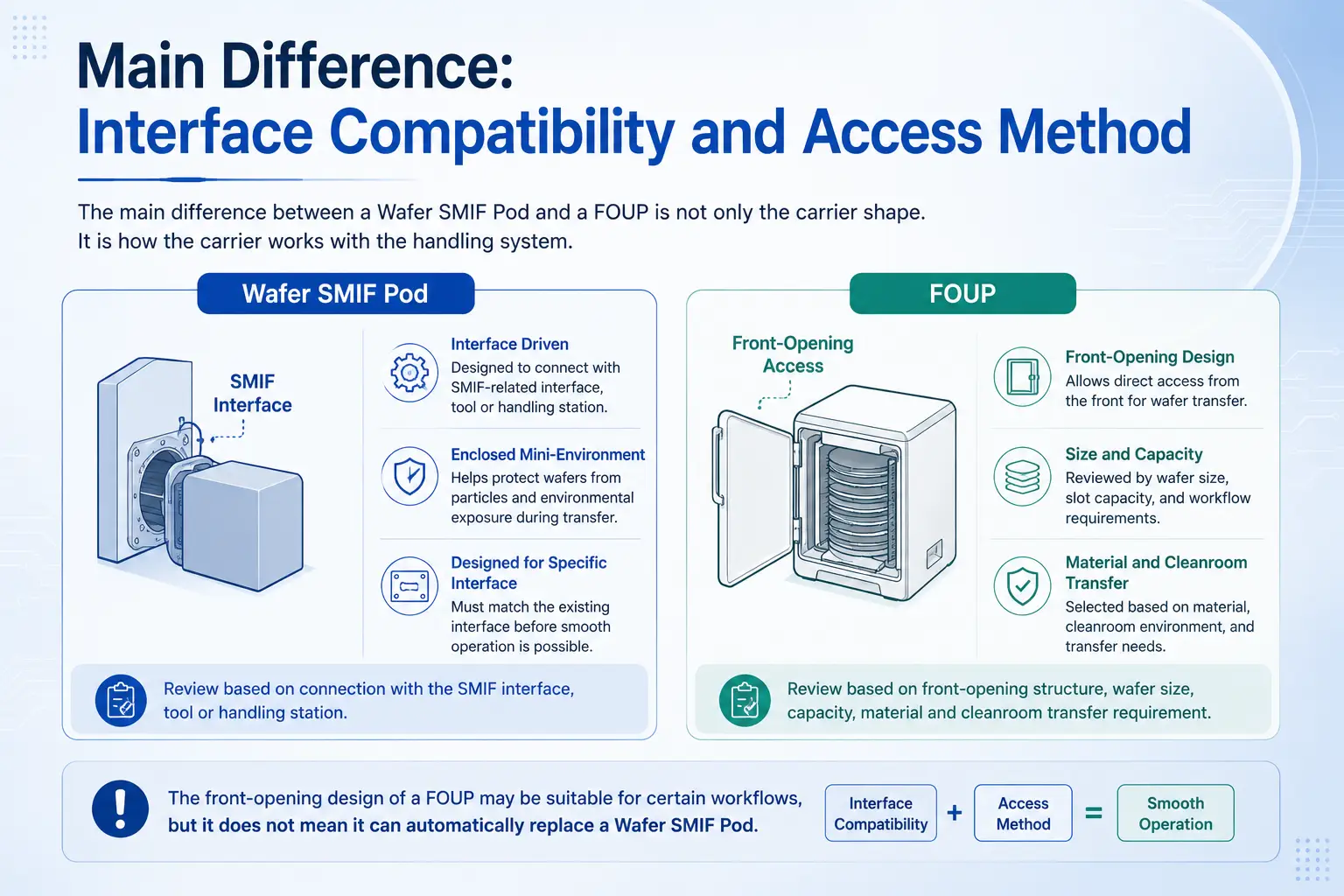
The main difference between a Wafer SMIF Pod and a FOUP is not only the carrier shape. It is how the carrier works with the handling system.
A Wafer SMIF Pod should be reviewed based on its connection with the SMIF-related interface, tool or handling station. If the process is designed around a specific interface, the pod must match that interface before it can be used smoothly.
A FOUP should be reviewed based on its front-opening structure, wafer size, slot capacity, material and cleanroom transfer requirement. The front-opening design may be suitable for certain wafer transfer workflows, but that does not mean it can automatically replace a SMIF Pod.
| Item | Wafer SMIF Pod | FOUP |
|---|---|---|
| Full Name | Standard Mechanical Interface Pod | Front Opening Unified Pod |
| Main Focus | Controlled wafer access and interface compatibility | Front-opening access and cleanroom wafer transfer |
| Key Requirement | Must match the SMIF-related tool, station or handling interface | Must match front-opening loading and wafer transfer requirements |
| Selection Focus | Equipment interface, loading method, pod structure, wafer size and slot design | Wafer size, slot capacity, front-opening design, material and ESD requirement |
| Replacement Risk | May not be replaced by a FOUP without interface review | May not work with SMIF-related systems without confirmation |
This comparison should be read as a practical selection guide. The correct carrier depends on the equipment and process, not only on the wafer size.
Can a FOUP Replace a Wafer SMIF Pod?
A FOUP may replace a Wafer SMIF Pod only if the actual handling process allows it. In many cases, replacement is not decided by the carrier alone. It depends on the tool interface, loading setup and wafer handling flow.
A FOUP-style carrier may be possible when:
- The process does not require a SMIF-specific interface
- The carrier is mainly used for wafer storage or cleanroom transfer
- Front-opening access matches the handling method
- Wafer size, slot capacity and slot pitch are compatible
- The equipment or station can accept the FOUP-style structure
A FOUP may not be suitable when:
- The process requires a SMIF-related interface
- The tool or station is designed for SMIF Pod handling
- The loading direction does not match
- The pod-to-tool connection is different
- The internal slot design does not match the wafer handling method
For practical use, replacement should be reviewed with the actual equipment layout. A carrier that looks correct by specification may still create loading or interface problems after installation.
When a SMIF Pod Setup Needs Careful Review
A SMIF-related setup needs careful review when the pod is part of a controlled wafer access system. In this situation, the carrier is not only used to hold wafers. It also needs to work with a defined interface, station or tool-side handling method.
Review is especially important when the pod connects with a specific tool or loading station. The interface must match the equipment design, and the loading method should support the way wafers are accessed during the process.
It is also important when replacing an existing pod. A replacement carrier should be checked against the current workflow before production, especially if slot pitch, pod dimensions, material or interface details are different.
In real production, carrier problems often appear during daily operation, not during quotation. This is why the interface and loading method should be confirmed before ordering.
When a FOUP-Style Carrier May Be Enough
A FOUP-style carrier may be enough if the process does not require a SMIF-specific interface and the main purpose is cleanroom wafer storage, transfer or front-opening access.
This may apply when wafers need organized storage or movement, and the handling process supports front-opening loading. It may also be suitable when ESD-safe material, RFID support, custom slot design or custom dimensions are needed for cleanroom transfer.
However, a FOUP-style carrier should still be reviewed against the actual equipment, loading method and wafer handling process. It should not be chosen only because it appears similar to a wafer pod.
What to Confirm Before Treating One as a Replacement
Before using a FOUP in place of a Wafer SMIF Pod, or choosing a SMIF Pod instead of a FOUP-style carrier, confirm the actual process requirements.
| Item to Confirm | Why It Matters |
|---|---|
| Equipment interface | Confirms whether the pod can connect with the tool, station or handling system. |
| Loading method | Determines whether SMIF-related handling or front-opening access is required. |
| Wafer size | Ensures the carrier fits the wafer diameter and handling object. |
| Slot design | Affects wafer spacing, support, loading stability and contact risk. |
| Pod structure | Determines whether the carrier can support the required access and handling flow. |
| Material requirement | Affects ESD control, durability and cleanroom handling suitability. |
| Transfer route | Helps confirm whether the carrier will be used for storage, transfer or equipment-side handling. |
The most important point is simple: a carrier that fits the wafer size may still fail if the interface or loading method is wrong.
YJ Stainless Wafer Pod and FOUP Support
YJ Stainless provides wafer pod and semiconductor carrier solutions for wafer storage, cleanroom transfer and process handling applications.
Depending on the process requirement, YJ Stainless can support Wafer SMIF Pod, FOUP-style wafer carrier and custom wafer handling carrier planning. Design considerations may include wafer size, slot quantity, slot pitch, material, ESD requirement, equipment interface, RFID support and custom dimensions.
Because SMIF Pod and FOUP are not the same product, YJ Stainless can help review the actual handling requirement before recommending a carrier structure.
If your process requires a Wafer SMIF Pod, FOUP-style carrier or customized wafer handling solution, YJ Stainless can help review your wafer size, interface requirement and cleanroom handling process before production.
Conclusion
A Wafer SMIF Pod and a FOUP are both used for semiconductor wafer handling, but they should not be treated as interchangeable products without review. A Wafer SMIF Pod is related to Standard Mechanical Interface handling and equipment-side access. A FOUP is a Front Opening Unified Pod used for front-opening wafer storage and cleanroom transfer.
The best choice depends on the actual process. Before replacing one carrier with another, confirm the equipment interface, loading method, wafer size, slot design, material and cleanroom handling requirements.
If you need a Wafer SMIF Pod, FOUP-style wafer carrier or custom semiconductor carrier, contact us to discuss your wafer handling process, interface requirements and custom carrier design.
FAQ
1. Are Wafer SMIF Pods and FOUPs the same?
No. Wafer SMIF Pods and FOUPs are related wafer handling carriers, but they are not the same. A SMIF Pod is related to Standard Mechanical Interface handling, while FOUP means Front Opening Unified Pod.
2. Can a FOUP replace a Wafer SMIF Pod?
Not always. A FOUP should not replace a Wafer SMIF Pod unless the equipment interface, loading method, wafer size, slot design and process requirements are confirmed.
3. What is the main difference between a SMIF Pod and a FOUP?
The main difference is the handling concept. A SMIF Pod focuses on controlled access and interface compatibility. A FOUP focuses on front-opening access and cleanroom wafer transfer.
4. When should I choose a Wafer SMIF Pod?
Choose a Wafer SMIF Pod when the process requires SMIF-related handling, controlled wafer access or compatibility with a specific tool or handling station.
5. What should I check before choosing a wafer pod?
Check equipment interface, loading method, wafer size, slot design, pod structure, material requirement and cleanroom handling process.