Wafer SMIF Pod Customization: What Information Should You Provide?
A custom Wafer SMIF Pod may be needed when a standard pod cannot match the wafer size, equipment interface, loading method or daily handling process.
In custom projects, wafer diameter is usually the easiest detail to confirm. The more difficult part is making sure the pod fits the tool, loading direction, station clearance and actual operating workflow.
A drawing can look correct, but the pod may still be difficult to use if the equipment interface or handling space was not confirmed early. Providing complete information before design review can reduce repeated revisions and lower the risk of mismatch after production.
This guide explains what information to prepare when requesting a custom Wafer SMIF Pod and which details should be confirmed before manufacturing begins.
For a general introduction to SMIF handling, refer to our Wafer SMIF Pod Guide. For replacement and compatibility questions, read Can You Replace a Wafer SMIF Pod with a FOUP?
When Is a Custom Wafer SMIF Pod Needed?
Not every wafer handling process needs a fully customized pod. A standard or semi-custom design may be enough when the wafer size, slot arrangement and handling method already match the process.
Custom design is usually considered when:
- The pod must fit a specific tool or loading station
- The loading direction differs from a standard design
- Wafer size or thickness is non-standard
- Slot quantity or slot pitch needs adjustment
- The pod must fit existing carts, shelves or storage areas
- ESD-safe material is required
- RFID or carrier identification needs to be added
- The standard pod does not provide enough clearance or handling space
The reason for customization should be clearly defined before discussing the final pod shape.
Start with the Equipment and Station Information
For SMIF-related handling, the equipment interface is often more important than the outside appearance of the pod.
Before design review, provide as much information as possible about the tool or station, including:
- Equipment model or station type
- Loading direction
- Interface location
- Available opening clearance
- Pod positioning method
- Manual or automated handling
- Contact points or supporting areas
- Space limitations around the station
Photos, drawings or dimensional sketches are especially useful. They allow the supplier to review how the pod will be positioned, opened and removed during actual operation.
A carrier may fit the wafer correctly but still fail if the cover cannot open fully or the pod does not align with the station.
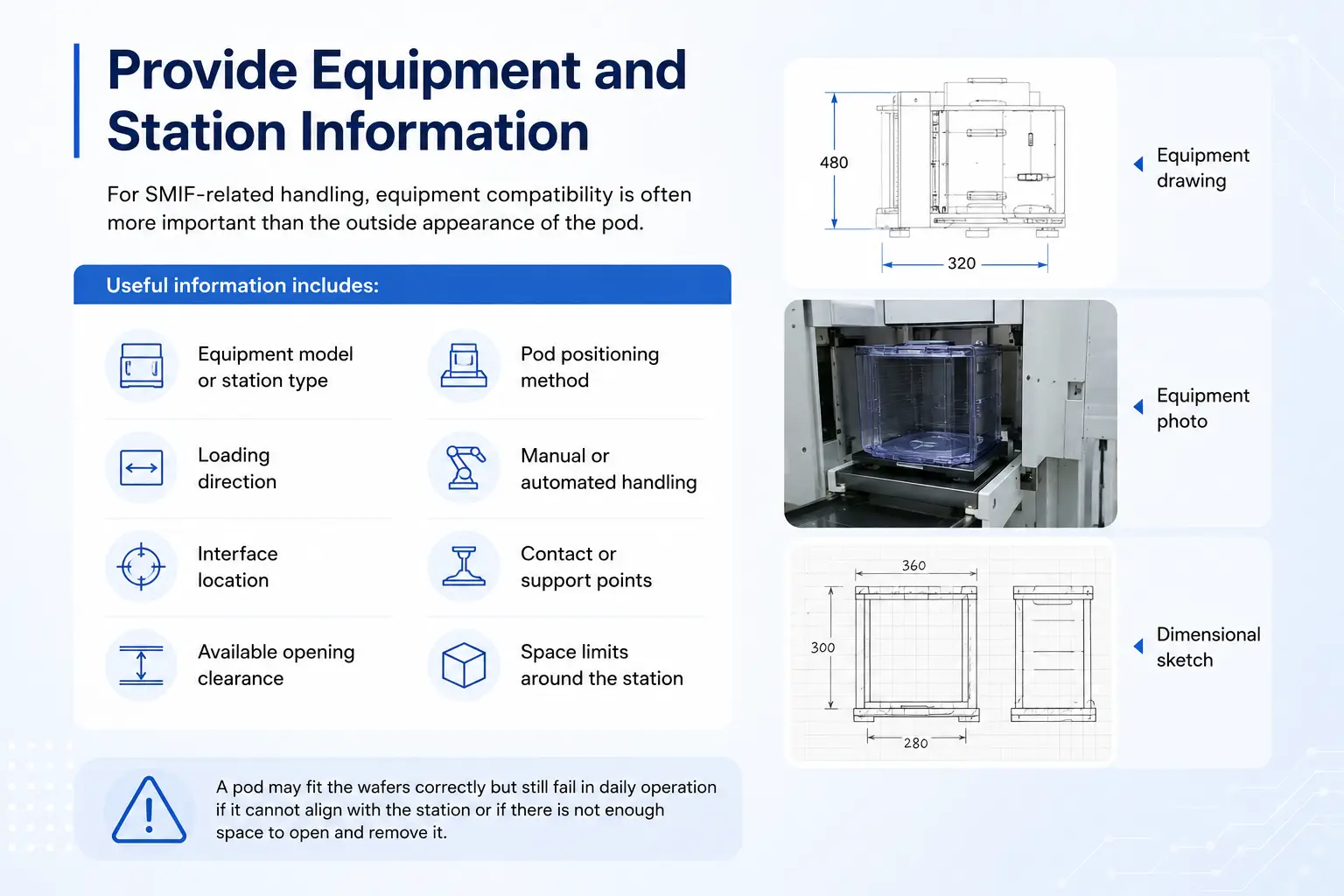
Provide Equipment and Station Information
For SMIF-related handling, equipment compatibility is often more important than the outside appearance of the pod.
Useful information includes:
- Equipment model or station type
- Loading direction
- Interface location
- Available opening clearance
- Pod positioning method
- Manual or automated handling
- Contact or support points
- Space limits around the station
Equipment drawings are helpful, but photos and dimensional sketches can also support the initial review.
A pod may fit the wafers correctly but still fail in daily operation if it cannot align with the station or if there is not enough space to open and remove it.
Confirm Wafer and Slot Requirements
The supplier needs accurate wafer information before designing the internal slot structure.
Confirm:
- Wafer diameter
- Wafer thickness
- Quantity per pod
- Required slot pitch
- Loading and unloading direction
- Internal clearance
- Whether empty slots are needed
- Any special wafer protection requirements
Slot quantity should not be decided only by how many wafers can physically fit inside the pod. The spacing should also allow stable loading and unloading without unnecessary contact.
Thin, processed or sensitive wafers may require different support or clearance from standard wafers. These conditions should be discussed early.
Confirm Pod Dimensions and Handling Space
Custom dimensions may be required when the pod must fit existing equipment, storage racks, cleanroom carts or workstations.
Provide the required:
- Overall length
- Overall width
- Overall height
- Maximum available space
- Opening clearance
- Handle position
- Carrying method
- Storage orientation
It is useful to separate fixed dimensions from preferred dimensions.
Fixed dimensions may be controlled by the equipment or station. Preferred dimensions may still be adjusted to improve strength, access or daily handling.
This gives the supplier more flexibility without affecting equipment compatibility.
Material, ESD and Tracking Requirements
Material should match the actual handling environment.
Before design review, confirm:
- Whether ESD control is required
- Cleanroom handling conditions
- Handling frequency
- Cleaning method
- Chemical exposure, if any
- Transparency or visual inspection needs
- Expected durability
For static-sensitive handling, ESD-safe material may be considered. However, the material should also match the cleaning method, cleanroom conditions and frequency of use.
RFID, barcode areas, serial numbers or labels should also be planned early. Adding tracking features after the structure is finalized may create clearance or positioning problems.
Standard, Semi-Custom or Fully Custom?
A custom project does not always require a completely new pod.
| Design Type | Suitable Situation |
|---|---|
| Standard Design | The existing wafer size, slot arrangement and pod dimensions already match the process. |
| Semi-Custom Design | Only selected details such as slot quantity, material, dimensions or RFID support need adjustment. |
| Fully Custom Design | A new structure is required to match a specific interface, loading method or handling system. |
A semi-custom design is often the more practical option when the existing pod structure is already close to the requirement. Fully custom development is more suitable when the equipment interface or handling method is significantly different.
Information to Prepare Before Requesting a Quote
Providing the following information can make the quotation and design review more efficient.
| Information Required | Details to Provide |
|---|---|
| Application | Storage, cleanroom transfer, equipment loading or process-side handling. |
| Wafer information | Diameter, thickness, quantity and special handling conditions. |
| Slot design | Slot quantity, slot pitch and required spacing. |
| Equipment interface | Tool model, loading direction, drawings, photos and clearance limits. |
| Pod dimensions | Required length, width, height and space limitations. |
| Material | ESD requirement, transparency, durability and cleaning conditions. |
| Tracking | RFID, barcode, serial number, label or logo requirements. |
| Project details | Estimated quantity, testing needs and expected production schedule. |
Equipment drawings and real handling information are especially useful when interface compatibility is important.
Design Review Before Production
Before manufacturing begins, the design should be checked against the actual wafer handling process.
Confirm that:
- The wafers fit the internal slot structure.
- The pod fits the equipment or station.
- The loading and opening directions are correct.
- There is enough clearance for daily use.
- The material matches the handling environment.
- Tracking features are in the correct position.
- Operators can place, carry and open the pod properly.
For a new structure or special equipment interface, prototype testing may be useful before full production. A physical test can reveal clearance or handling issues that are difficult to identify from drawings alone.
YJ Stainless Custom Wafer SMIF Pod Support
YJ Stainless provides custom wafer pod and semiconductor carrier solutions for cleanroom storage, transfer and equipment-side handling.
Custom planning may include:
- Equipment interface review
- Slot quantity and pitch adjustment
- Custom pod dimensions
- ESD-safe material options
- RFID and identification support
- Loading and access design
- Cleanroom handling requirements
To begin a custom project, provide your wafer specifications, equipment information, loading method and required pod dimensions. YJ Stainless can review whether a standard, semi-custom or fully customized design is more suitable.
Conclusion
A custom Wafer SMIF Pod should be designed around the actual equipment and wafer handling process. Wafer size is important, but it is only one part of the design.
Providing equipment drawings, loading details, slot requirements, dimensions, material needs and tracking information early can reduce revisions and improve compatibility before production.
If you need a custom Wafer SMIF Pod, contact us to discuss your equipment interface, wafer specifications and cleanroom handling requirements.
FAQ
1. What information is needed for a custom Wafer SMIF Pod?
Provide wafer size, thickness, slot quantity, slot pitch, equipment interface, loading method, pod dimensions, material requirements and tracking needs.
2. Do I need to provide an equipment drawing?
A drawing is recommended when the pod must fit a specific tool or station. Photos and dimensional sketches can also help during the initial review.
3. Can only the slot quantity or dimensions be changed?
Yes. A semi-custom design may be enough when the existing pod structure already matches the process and only selected specifications need adjustment.
4. When is a fully custom pod required?
A fully custom design may be required when the pod must match a unique equipment interface, loading direction, station layout or handling workflow.
5. Can RFID and ESD-safe material be added?
Yes, depending on the application and design. These requirements should be confirmed early because they may affect the pod structure and material selection.