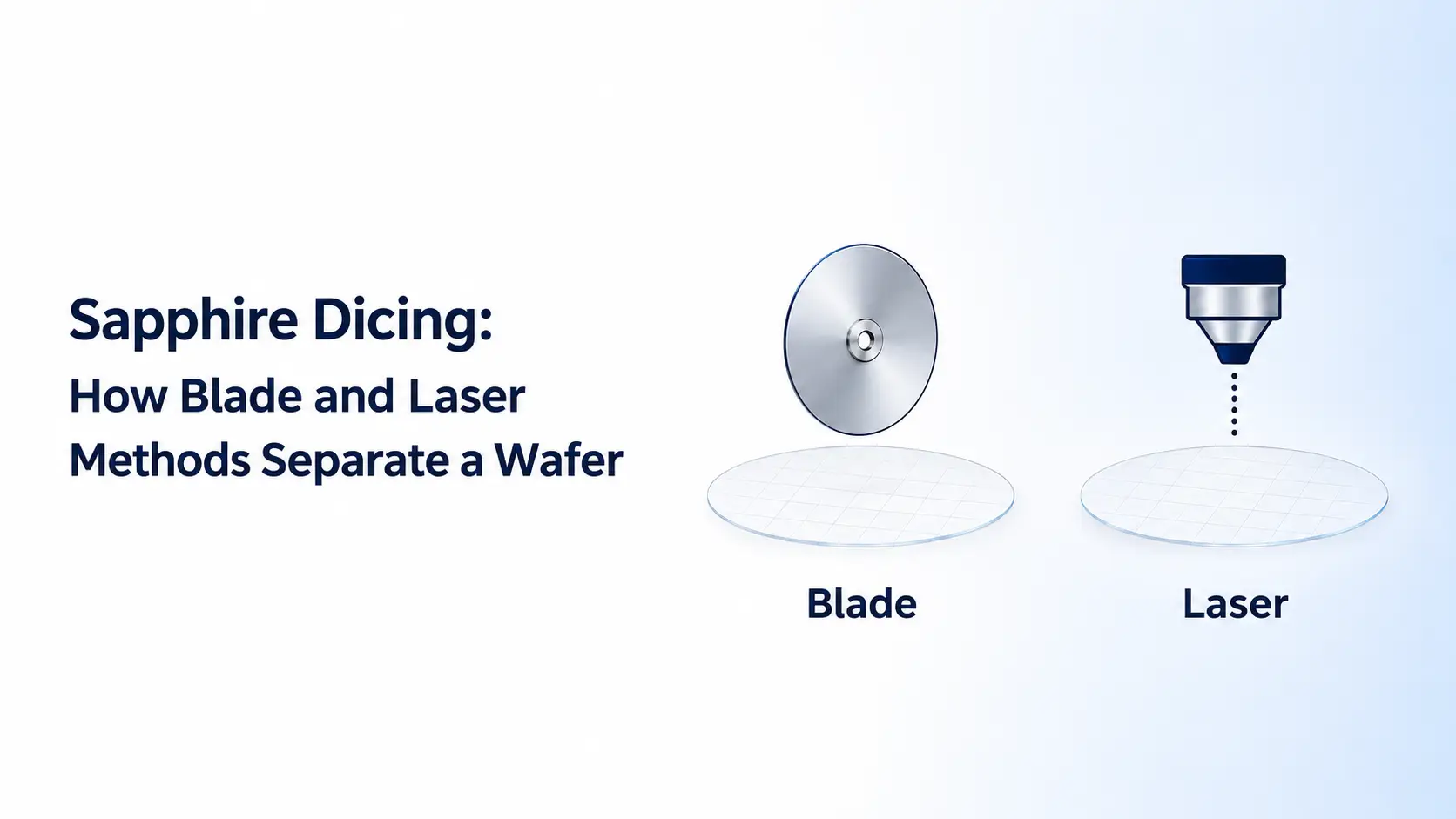
Sapphire Dicing: How Blade and Laser Methods Separate a Wafer
Sapphire dicing separates a sapphire wafer or substrate into individual dies or smaller parts. A diamond blade can cut through the substrate. A laser can form a surface groove that guides a later break or create a modified region inside the sapphire along which the dies separate. The choice depends on the space between devices, the substrate thickness, and the required condition of the finished edge.
For lines that use frame-mounted tape, we also explain when a change in wafer size calls for a review of the stainless steel frame.
What Determines Whether a Sapphire Dicing Method Fits the Layout?
Sapphire is a hard, brittle form of single-crystal aluminum oxide. In LED manufacturing, many devices can share a sapphire wafer before separation. The space allocated between neighboring devices is called a dicing street. In blade dicing, the kerf is the width of material the blade removes as it travels along that street.
Even when the blade kerf fits within the street, edge chipping can extend closer to a device than the cut itself. Substrate thickness also matters. The UC San Diego Nano3 dicing facility publishes different street-width capabilities for silicon and sapphire on its saw and explains that its minimum street width depends on cutting depth. Before carrying a layout over from silicon to sapphire, a process team can compare the planned street width and substrate thickness with the facility’s capabilities.
How Do Sapphire Dicing Methods Compare After Separation?
| Method | How the dies separate | What to examine on a trial wafer |
|---|---|---|
| Diamond blade dicing | A rotating abrasive blade removes material along the street. A through-cut separates the sapphire in the saw. | Does the cut stay within the allocated street? Is edge chipping on both faces within the limits specified for the part? |
| Laser scribing and breaking | A laser forms a surface groove. A subsequent breaking step separates the wafer along the scribed path. | After breaking, does the edge follow the intended line through the substrate, including at the die corners? |
| Stealth dicing | A laser forms a modified region inside the sapphire. A later step, such as tape expansion, separates the dies. | Do the dies separate along the intended paths? After pickup, do their edges meet the acceptance criteria? |
Diamond Blade Dicing for Sapphire
Blade dicing is an option for full wafers and smaller sapphire pieces. The EPFL dicing saw guide explains how the bond that holds the diamond abrasive influences blade selection for hard, brittle materials such as sapphire.
On a trial part, the front and back edges both warrant inspection. For example, a cut may follow the intended street when viewed from above, while a chip on the underside extends beyond the permitted area. Comparing both faces with the drawing gives a fuller assessment of the finished die.
Laser Scribing and Stealth Dicing for Sapphire LEDs
With laser scribing, the surface groove shows where the wafer is intended to break. The full edge becomes visible after the breaking step. In stealth dicing, the laser acts inside the wafer, and the separated edges can be assessed after expansion or the specified separation step.
DISCO’s sapphire processing examples show both approaches on sapphire substrates used for LEDs. They also explain why internal processing can be attractive when a design calls for narrow streets. For an LED wafer, the comparison can extend beyond die dimensions and edge appearance to the light output of the separated devices.
How Dicing Tape and Metal Frames Work Together
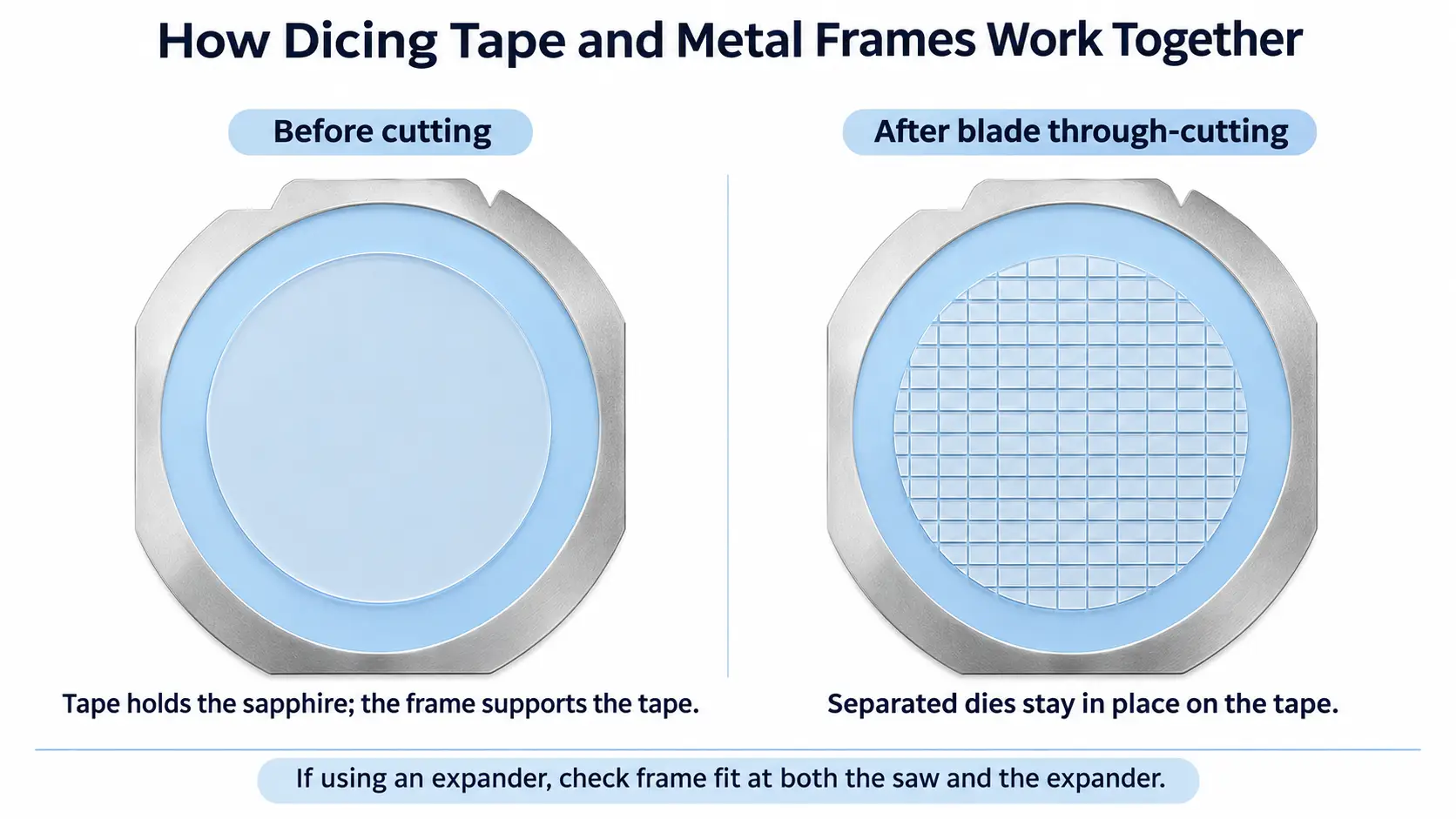
In a frame-mounted setup, the sapphire adheres to the tape, and the frame holds the tape around its perimeter. During blade through-cutting, the tape can keep the separated dies in their original arrangement for handling.
POWATEC’s dicing service overview lists sapphire among the materials it processes and describes tape mounting on frames and die expansion among its services. If a mounted wafer moves from the saw to an expander, the frame must fit both stations.
Custom Stainless Steel Frames for Sapphire Dicing Equipment
At YJ Stainless, we manufacture stainless steel frames for sapphire dicing setups that use frame-mounted tape. We can work from an equipment builder’s drawing for a new machine or from an approved part drawing when a production team needs replacement frames.
A larger sapphire wafer, for example, may need more usable tape area while the loader still requires the same outer frame profile. If your equipment team specifies a revised opening, we can review the drawing and assess how to manufacture the frame while retaining the required thickness and loading features.
Our frame customization services include CNC machining and laser engraving. If your line uses several similar frames, we can engrave a part number so operators can identify the correct version during setup. For a manufacturing review, you can send us your frame drawing with the required dimensions and any proposed changes.
Conclusion
Street width and substrate thickness help narrow the choice of sapphire dicing methods. To compare trial results, examine the finished dies after each method has completed separation: after the through-cut for blade dicing, after breaking for laser scribing, and after expansion for a stealth dicing process that uses tape expansion.
At that point, the same acceptance criteria can be applied to each sample. Are the die dimensions within tolerance? Is edge chipping within the permitted limits? For sapphire-based LEDs, the evaluation can also include the light output of the separated devices.
FAQs
1. Can a sapphire wafer be cut with a dicing saw?
Yes. Dicing facilities use diamond abrasive blades to cut sapphire. To assess a particular job, a facility needs the substrate thickness, available street width, and acceptance criteria for the finished edges.
2. How much street width does sapphire dicing require?
The required width depends on the process and part geometry. For blade dicing, the layout needs to accommodate the kerf, positioning tolerance, and allowable edge damage. A facility’s published minimum is most relevant when it applies to the same material, equipment, and cutting depth as the proposed job.
3. How can blade and laser dicing trials be compared fairly?
Compare dies after each process has completed separation. Inspect the same edges and corners against the same acceptance criteria. For LED devices, include the performance requirements that apply after singulation.
4. Does a sapphire wafer need a special metal frame?
An existing frame may already meet the requirements. In a tape-mounted setup, the substrate size helps determine the usable opening, while the mounting, loading, and handling equipment define the required interfaces.
5. What information helps YJ Stainless review a replacement frame?
An approved drawing showing the outer profile, opening, thickness, material, and critical tolerances is a useful starting point. If the replacement includes a design change, identifying the revised feature helps us assess the manufacturing request.